



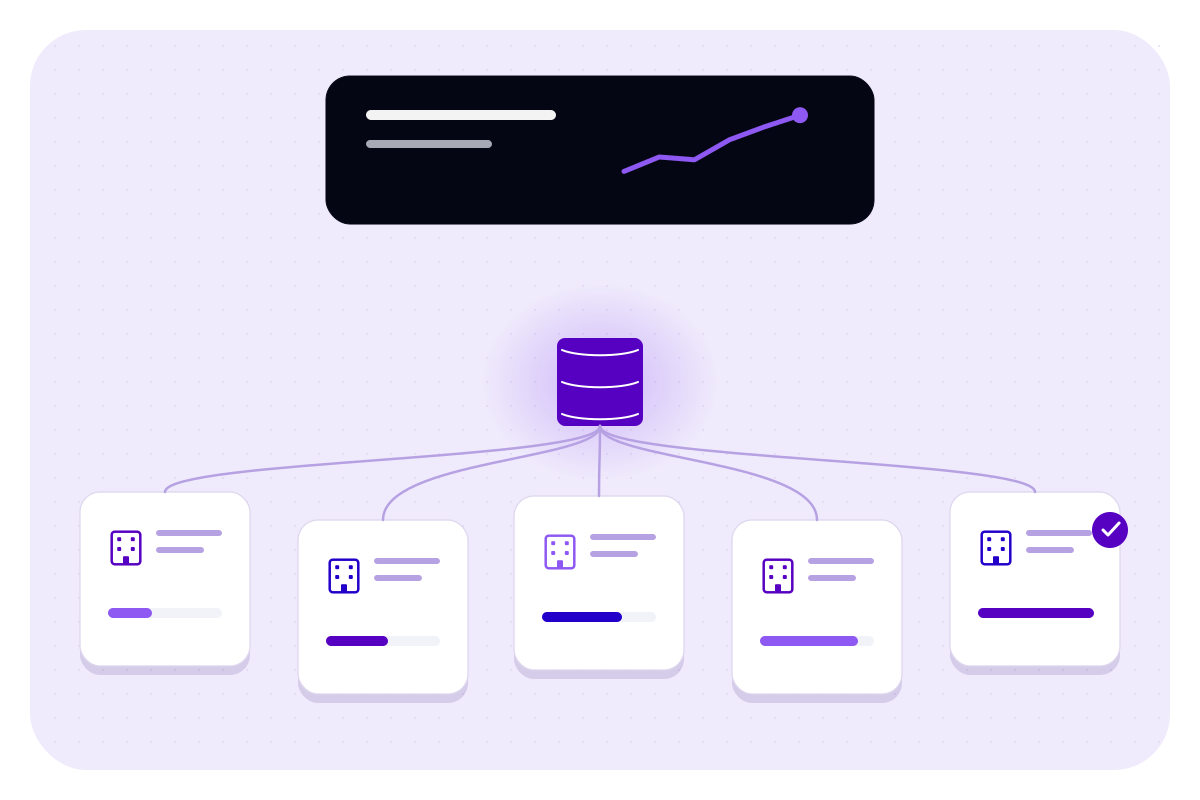
Every company reports differently
When pipelines, definitions and data diverge, comparing your portfolio becomes a manual reconciliation exercise instead of a foundation for decisions.
For private equity teams and portfolio companies
More revenue from existing client relationships, fewer duplicated costs and a commercial system that also works for your next acquisition. We help you build these levers across your portfolio and make their contribution to the plan visible.
Estimate the value leverThree inputs, an initial estimate. No meeting or email address required.
Experience with portfolio companies and growth-oriented businesses




The fund perspective
A shared CRM is a means to an end. It should reveal where portfolio companies share clients, where revenue opportunities go untapped and which costs are duplicated. That creates actions, ownership and verifiable figures for the plan.
The lever works in two ways: higher EBITDA increases enterprise value at the same multiple. Traceable growth and client data can also improve the discussion of quality and risk at exit, without guaranteeing a higher multiple.
Illustrative example · not a client result
An initial estimate
Enter three assumptions of your own. The result is a scenario for additional revenue and earnings contribution, not a forecast.
These are your assumptions. Additional implementation and sales costs are not included.
Your scenario
—additional annual revenue —potential EBITDA contribution before additional costs Estimate licence savingsThe operating lever
When shared client data, cross-selling and repeatable sales execution generate additional revenue while fixed costs rise more slowly, the gap between the two lines grows: the potential EBITDA contribution.
The starting point
When pipelines, definitions and data diverge, comparing your portfolio becomes a manual reconciliation exercise instead of a foundation for decisions.
Acquisition and sales work while experienced people carry everything themselves. The next growth step needs a repeatable sales process.
Shared clients, offers and sales opportunities are known. Without ownership, a data foundation and an execution rhythm, they are not pursued in everyday work.
Today: separate views of figures, teams and opportunities.
Afterwards: clear ownership and a regular decision rhythm.
Why now?
One portfolio company can explain its own sales figures. Once another joins, leaders need to make decisions across different pipelines, client data and sales processes.
If you wait until the next planning round or an exit to put things in order, you reconstruct the journey afterwards. Agreeing definitions and ownership early makes progress visible as it happens, without forcing every company into the same mould.
Working together
We start with your value creation plan. Your starting point determines the scope, sequence and tools.
Together with you and the portfolio company teams, we review the revenue and efficiency assumptions in the plan and identify the data missing from a reliable baseline.
Depending on your starting point, we connect client data and reporting, unlock cross-selling opportunities or build repeatable pipeline generation.
You see which actions contribute to revenue and earnings, which assumptions do not hold and what the team needs to change next.
Practical starting points
Make client data, pipeline and cross-selling usable across portfolio companies, with a shared foundation and clear local ownership.
Explore group-wide CRMReduce manual research and repetitive work so sales teams have more time for relevant client conversations.
Explore Clay & GTM efficiencyBuild repeatable outreach and clear handoffs so growth can extend beyond individual networks and short-term campaigns.
Explore pipeline generationA practical example
For a buy-and-build group, a shared view of client relationships can be the starting point for cross-selling. This example illustrates the constraint, without promising a universal result.
“Sometimes there's three labels supporting one company. Sometimes we don't even know about that. Sometimes the customer doesn't even know about that.”Is this a fit for you?
This is a fit when your fund or portfolio company wants to implement a concrete commercial lever with an accountable team. If you only need a financial or transaction CRM for deal flow and investor relations, our specialism does not fit that requirement.
Read our client storiesBoth are possible. The starting point depends on where the decision and constraint sit: within one company or in a task that connects several portfolio companies.
No. First we clarify which data and workflows need to be shared and where local differences remain useful. A group-wide CRM is one possible solution, rather than a prerequisite for every project.
We discuss your starting point, the trigger and the teams involved. Then we tell you openly which lever makes sense and whether we are the right partner for it.
We agree specific goals and measurements after reviewing your starting point. A general revenue or EBITDA promise would be unreliable without that foundation.
The next step
The licence savings calculator gives you an initial estimate. For group-wide CRM, we show you how client data and cross-selling can work across portfolio companies.
Quick diagnosis
Choose the area where you need the most clarity right now.
Pipeline check
Choose the constraint that comes closest to your current situation.
Sixty seconds
Licences, tool sprawl and lost selling time: run the business case with your own numbers.
Forecast check
Choose the situation that is holding your sales team back most right now.
No pitch
Leave your details and we will come back with an honest read on whether and how we can help.
No pitch
We will get in touch with an honest view of which constraint should be solved first.
No pitch
We will get in touch with an honest view of whether HubSpot and our approach fit your situation.
No pitch
We will get in touch with an honest view of deals, forecast and sales leadership.