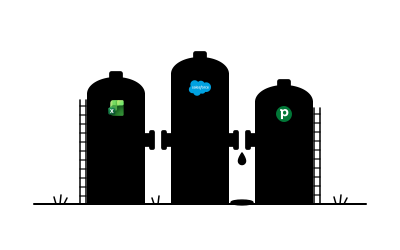
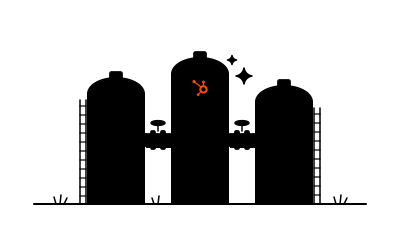
A buy-and-build platform rarely inherits one CRM. It inherits five. Salesforce at the platform, Microsoft Dynamics at one add-on, an unconfigured HubSpot at another, Pipedrive at the next, and nothing at all at the one you just signed. Group-level reporting on marketing, sales and customer service does not exist. We consolidate the portfolio onto one HubSpot portal inside the first twelve months of the hold period — so the value creation plan is auditable from month one, not written up three weeks before the exit.
Every acquisition arrives with its own stack, its own definitions, and its own view of the pipeline. By add-on number three, the group cannot answer the simplest questions: how much pipeline is real, what the blended customer acquisition cost looks like, and whether the cross-sell synergies in the value creation plan are actually happening. The CRM is not a software decision. It is the operating layer of the buy-and-build thesis.
After three to ten acquisitions, the platform company runs on four to five different CRMs plus twenty to forty satellite tools. None of them talk to each other. Each local managing director swears by their own.
The cost is rarely booked as one line. It sits in license sprawl, duplicate headcount, rekeying work, and the revenue leakage that comes from every portfolio company running its own definitions.
Something forces the call. The kickoff of the value creation plan, the onboarding of a group chief revenue officer, the first full limited-partner pack, or the bolt-on that finally breaks the reporting structure.
Hold periods are two to four years. Every quarter that the stack is left alone, the integration debt compounds, the data room gets messier, and the exit diligence gets more expensive. This is not work that moves with you — it moves against you.
Owners who move fast optimise for the same five things — because open-ended consulting scopes and systems-integrator timelines are exactly what a hold period cannot absorb.
Each portfolio company was bought for its customer base, its management, or its product. None of them were bought for their CRM. By the time the group has three or more brands, the stack looks like this on the left — and needs to look like the right before the first full year-end group audit.
Four to five CRMs, zero group view.
One portal, one data model, one group view.
When marketing, sales and customer service data live in five places, three stakeholders lose every quarter — the operating partner, the portfolio chief financial officer, and the limited partners reading the annual report. We size the consolidation backwards from the reports those three actually need.
Consolidation pays back on two independent levers — a top-line lever and a bottom-line lever — plus a reporting lever that earns its keep at the exit. All three compound over a two to four year hold.
One contact database across all brands. One marketing engine. One customer view. Cross-sell campaigns stop being a slide and start being a pipeline, because the data is finally in one place to target against.
Five CRMs become one. Twenty to forty satellite tools become five to eight. Local revenue operations spend becomes a group function. The integration debt that each portfolio company carries separately is retired once, centrally.
Pipeline, customer acquisition cost, gross retention, net retention and cohort economics — produced the same way across the group, every month, traceable to source. The data room is ready months before the process starts, not weeks.
Four inputs. One consolidated number you can take into the next value creation plan review.
Honest numbers in. A defensible range out.
Benchmarked from recent SalesPlaybook buy-and-build engagements.
A buy-and-build consolidation is a sequenced programme, not a big-bang migration. Revenue keeps closing in the old stacks while the central HubSpot is stood up; each portfolio company is cut over on a fixed Friday; and group reporting goes live on day one of the platform phase, getting richer with every add-on that joins.
A two-to-four year hold almost always sees a new group chief revenue officer land in year one and a new chief marketing officer in year two. The stack they inherit decides how fast they can make the value creation plan real. One HubSpot makes the handover a half-day exercise, not a three-month forensic rebuild.
In the portfolio we see most often, a new group chief revenue officer comes in between months six and twelve — brought in to execute the value creation plan. They arrive to find the answer to "what is the pipeline" scattered across five systems. They spend their first quarter forensically rebuilding it. That is a quarter the hold period does not have.
One central HubSpot changes the handover. The incoming group chief revenue officer inherits a single portal with defined lifecycle stages, named pipelines per brand, cross-sell attribution, and live limited-partner reporting. The operating partner sees the same picture the chief revenue officer sees. So do the local managing directors. And when the same thing happens on the marketing side a year later, it happens again without rebuilding anything.
This is what "operating layer" means. The people move. The number does not.
Two recent buy-and-build-style consolidations — one group built by acquisition across Europe, one group with four brands serving more than a hundred and thirty revenue and service users on a single portal.
A European buy-and-build platform combining nine specialist firms — more than four hundred employees, sixty-four million euros in revenue in 2024 — inherited a stack that included Salesforce at one firm, AFAS, MOCO and Exact on the finance side, Pardot on the marketing side, and partial CRM setups across the rest. The rollout sequenced one company every two weeks, or two batches of four, consolidating marketing, sales and customer service onto one HubSpot portal while local operations kept running.
Talk to us about the same pattern →A multi-brand group serving business-to-business customers across DACH and Austria consolidated four brands — plus their Microsoft Dynamics finance backbone, a separate data warehouse, and two prior HubSpot instances — onto one central HubSpot. Marketing, sales and service for one hundred and thirty users moved to the same portal. The group operates under a twenty-five percent year-on-year growth mandate with flat headcount, so every consolidation step had to be measured against revenue productivity, not just tool spend.
Talk to us about the same pattern →Consolidations fail for predictable reasons. We have run enough of them to name each failure mode and the mitigation we apply before it becomes a problem. Full transparency — written into the statement of work, before signing.
A proper portfolio-wide CRM consolidation — platform company plus four to nine add-ons, including Salesforce, Dynamics and Pipedrive migrations — runs twelve to eighteen months with us. Not the three years a systems integrator quotes. The operating partner sees the first group dashboards in week eight. The exit process starts with data the buyer trusts.
Benchmarks based on recent scoped engagements — including a nine-firm European consolidation and a four-brand group rollout. Your final number depends on inherited stack, integration scope and rollout cadence, all confirmed before signing.
The central HubSpot portal, business-unit architecture for each brand, marketing, sales and service hubs live on the platform company. First group dashboards.
Platform plus four to nine add-ons onboarded sequentially. One company every two weeks, or two batches of four. Each cutover is fixed-scope and co-owned with the local managing director.
Ongoing revenue operations partnership with senior HubSpot expertise. Bi-weekly working sessions, hands-on portal work, limited-partner reporting maintenance, and onboarding for new add-ons as they close.
All prices in CHF, fixed-scope, invoiced against agreed milestones. HubSpot licences purchased by the group directly — we advise on seat count, contact tier and multi-company native discounts. Reference-client discount available on multi-company commitments. Final investment structure confirmed in the portfolio CRM audit before signing.
A senior HubSpot consultant walks through your portfolio's inherited stacks — Salesforce, Microsoft Dynamics, HubSpot, Pipedrive, spreadsheets — names the six biggest drags on the value creation plan, and outlines a fixed-scope path to one group portal. No slides, no pitch, no obligation. Sized for the operating partner or the group chief revenue officer.